

Case study — Xpollens automates and scales the reconciliation of its payment flows
“Thanks to XREC, Xpollens has secured and automated its reconciliation processes, while giving its teams greater autonomy to support the development of its business. The result: less manual processing, greater reliability and a solution that can evolve quickly to support new payment flows, currencies and business use cases.”

Product Manager at Xpollens
Sections
Context
Xpollens is BPCE Group’s embedded payments platform. It enables companies to use payments as a lever for growth and revenue, through white-label payment services available in real time.
This model brings a specific requirement. Xpollens operates its clients’ flows and must be able to justify every movement at any time, with the level of traceability expected by the regulator.
Xpollens in figures
of flows in 2025
active accounts in 2025
active cards in 2025
Xpollens, internal source 2026
Reconciliation challenges at Xpollens
Operating payment flows on behalf of third parties requires systematic, disciplined control. Every euro received must be matched to an identified transaction, every discrepancy must be explained, and the whole must remain demonstrable to an auditor as well as to a regulator. As volumes, currencies and use cases multiply, this requirement does not fade: it intensifies.
Growth that called for a new tool
Before XREC, Xpollens carried out bank reconciliation of its transactions with an in-house solution. As the business grew, needs changed: every new payment method, every new currency and every new file format required custom development. The business teams also wanted greater autonomy to adapt the reconciliation rules themselves, without depending on IT.
A regulatory requirement to justify flows
Xpollens’ obligations regarding the safeguarding and release of funds go hand in hand with the obligation to justify all bank movements affecting its clients’ accounts. This is not a one-off end-of-period exercise: it is a capacity to demonstrate that must be maintained continuously, transaction by transaction.
The reconciliation framework therefore becomes a compliance asset as much as an accounting tool. It must produce evidence, not just a figure.
Growth across multiple flows
Xpollens’ activity keeps expanding, driven by new clients and new payment methods. Each extension brings new file formats and new matching rules to integrate.
With a framework dependent on in-house development, every change mobilised the technical teams. The challenge was therefore twofold: absorb growing volumes while maintaining performance, and make the business teams autonomous so that rules can evolve at the pace of the business.
Automation at scale, in the service of trust
For challenges of this kind, automating reconciliation at scale is about more than productivity. It changes the nature of the teams’ work: instead of reconstructing what is supposed to match, they focus on what does not.
Three effects add up:
- Volume stops being a limiting factor. A deterministic reconciliation engine processes large volumes within short timeframes and in a repeatable way, day after day.
- The audit trail becomes native. The rules applied, the matches made and the manual actions are logged, which makes it possible to demonstrate that a control is in place rather than simply assert it.
- Configuration returns to the business. When reconciliation rules and analysis scopes can be configured without development, the tool keeps pace with the business instead of slowing it down.
It is this combination — automation at scale, traceability and configuration autonomy — that distinguishes a reconciliation tool from a simple control mechanism.
Xpollens × Calixys
The need
Xpollens wanted to automate and scale its bank reconciliation framework to gain business autonomy and the ability to evolve, while retaining the capacity to justify all flows affecting its clients’ accounts, in line with the safeguarding requirements of the ACPR (the French Prudential Supervision and Resolution Authority).
Three criteria structured the search:
- Agility and source-agnostic design: a solution able to ingest heterogeneous data sources without requiring a redesign, and to fit into a broader information system transformation project.
- Business autonomy: the ability to create and evolve reconciliation rules without depending on in-house development.
- Scalability: absorbing growth in volumes, currencies and use cases without adding operating workload.
The choice of XREC was supported by prior knowledge of the solution within the teams, as well as by recommendations from within the BPCE Group.
The solution
XREC is Calixys’ reconciliation platform: it ingests flows from multiple sources, matches them according to rules the business can configure, isolates discrepancies and keeps a record of every processing step.
At Xpollens, the deployment relied on three levers.
Configuration handed back to the business
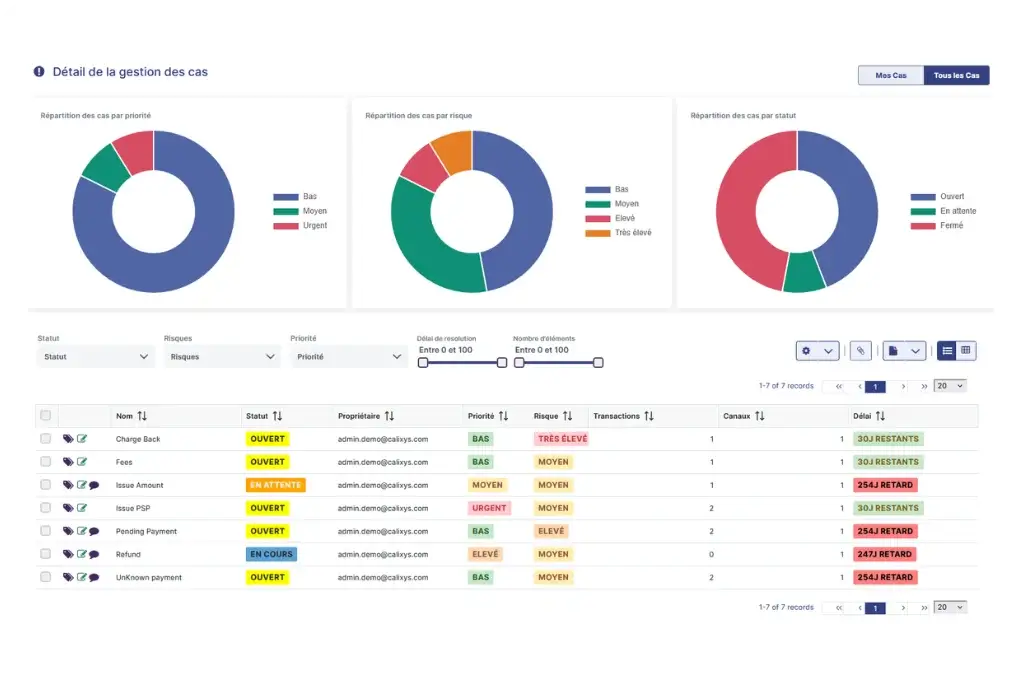
Adding a new reconciliation rule no longer requires development: the teams create and adjust their rules directly in the tool. The “cubes” logic also makes it possible to segment analysis scopes — by activity, by client, by currency — and to create new ones autonomously.
Daily exports
Beyond the platform’s dashboards, the generation of customised daily exports makes it possible to share information, feed audit work and retain an analysis capability outside the tool. Several manual tracking files have thus become obsolete.
End-to-end traceability
Detailed logs make it possible to verify that all data has been properly integrated, to secure processing and to facilitate investigation of discrepancies.
On the project side, the Xpollens teams benefited from daily support during the testing phase. The initial onboarding remains technical: Calixys provides video training modules and an e-learning path to speed up the upskilling of new users and sustain autonomy over time.
The result
automatic matching rate observed
transactions reconciled since the start
of processing time saved per day
Beyond the indicators, the benefits reported by the teams fall into four areas:
- Automation and refocusing. Recurring processing is handled by the platform. The teams now only work on unmatched transactions, which frees up time for analysis and higher-value tasks.
- Visibility on discrepancies. The solution provides a consolidated, up-to-date view of discrepancies, where the information was previously pieced together from several files.
- Autonomy and reduced technical dependency. There is no longer any need to develop or maintain an in-house solution: the workload on technical teams decreases and the business gains responsiveness in managing its rules.
- Scalability and new flows. New foreign-currency flows (Polish zloty, Romanian leu) are now handled, and four new cubes have been configured independently. Higher volumes are absorbed without any impact on performance.
Feedback from the teams
Interview with Jean-Baptiste BODHUIN, Product Manager at Xpollens
What was your situation before XREC?
“Before XREC, we already had an in-house bank reconciliation solution that met our historical needs. But with the growth of our business, the broadening of our payment offering and the gradual arrival of new currencies, maintaining and evolving this tool was becoming increasingly complex.
In addition, our operational teams had little autonomy to analyse discrepancies, manage exceptions or evolve the reconciliation rules. Every adaptation required the involvement of the IT teams, which lengthened lead times and limited our agility.
We were therefore looking for a solution that would give us greater business autonomy, better scalability and enhanced visibility on how reconciliations are processed.
We were therefore looking for a solution that would give us greater business autonomy, better scalability and enhanced visibility on how reconciliations are processed.
Jean-Baptiste BODHUIN
Product Manager at Xpollens
What did you expect from a reconciliation solution?
“We needed an agile, source-agnostic solution, able to fit into our information system transformation project and to reduce technical complexity and in-house development workload. One point was non-negotiable: being able to justify all the bank flows affecting our clients’ accounts, in line with the regulatory requirements on safeguarding and release of funds.”
What has XREC concretely changed in your day-to-day work?
“Three things. First, configuration flexibility: we can quickly add new reconciliation rules without depending on IT, and we create new cubes to segment our activities — multi-currency, for example. Second, visibility on discrepancies, with daily exports that complement the dashboards and are used for distribution as well as for audit or analysis outside the tool. Finally, the peace of mind that comes with traceability: the detailed logs allow us to check that all the data has been properly integrated.”
And what next?
“We see strong potential around AI applied to reconciliation: help with analysing unmatched transactions, which is still fairly manual today, and automatic suggestion of rules based on recurring reconciliation patterns. That is exactly the focus of our discussions with the Calixys teams.”
Calixys' response – the product roadmap
These expectations align with work under way at Calixys on AI applied to reconciliation, designed as a copilot. A first version will help configure reconciliation rules, assist in diagnosing complex discrepancies and suggest resolution options — with the decision always remaining with the user, on a deterministic and auditable processing foundation. Later versions will aim to guide decision-making and make validation more autonomous.
Calixys thanks the Xpollens teams for their trust and for the quality and transparency of our exchanges.

